Showing posts with label sarsen. Show all posts

Wednesday, 6 January 2021

A Brave New World - Sarsen Technology in 2021

Happy new year! We hope all our customers and colleagues had a happy and safe festive break.

Here at Sarsen, we are starting the year with cautious optimism, despite the current restrictions to movement and social interaction. The news that the vaccine from Oxford-AstraZeneca has been approved for use alongside the Pfizer inoculation provides a badly needed ray of hope in what has been an extraordinary 12 months across the planet.

Sarsen has been fully functional throughout the pandemic, with the shift to working form home being made seamlessly thanks to the cloud-based programs we use like Salesforce and Xero, as well as the flexibility and willingness of staff to accommodate changes at very short notice. 

 Following a busy 2020, we are determined that business will continue to move forward, and we are working very hard to ensure you do not see a decrease in service or support.

We’re all set up in our home offices, and you can continue to contact individual staff members via their usual email addresses or on our general email: info@sarsen.net.  We are also able to receive enquiries by phone on 01672 511166 or via our website: Contact Us. Individual staff mobile numbers are available to customers and are noted in the signature field on emails.

Following the latest Government instructions, we are continuing our digital first strategy, holding all meetings and customer interactions online, via phone or using a wide range of conferencing facilities as required. 

We are able to use almost every available online tool, including WebEx, Zoom, Skype, Teams and GoToMeeting, and after a bit of reluctance from the team (looking at you Stuart) video conferencing has become the norm. Its also nice to have an excuse to brush your hair once in a while during lockdown.

The whole team is making a superb effort to ensure that an excellent level of communication is maintained between ourselves, the manufacturers we represent, and our customers during this period of uncertainty. Please do not hesitate to get in touch if we can support your projects in any way.

We look forward to working with you in 2021!
 

Wednesday, 15 April 2020

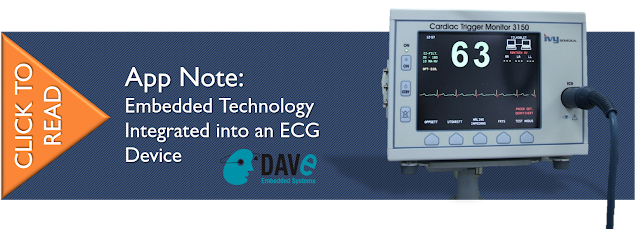
Embedded Technology Integrated into an ECG Device

Embedded electronics have never been so popular within the design of new products, especially when operators require touch screen technology for interaction and quick start operation. Based on this "mobile phone" style approach, customers in the medical market have started requesting new features for their devices, including capacitive touch screens, modern Graphical User Interfaces and Wi-Fi capabilities for remote control and monitoring.

One of the key medical areas where this technology is being utilised is in the design of ECG machines. In this app note, we look at how DAVE Embedded Systems is using their specific knowledge in this industry to design and develop a system able to support a rich and modern user experience including Wi-Fi or 4G connectivity, which provides access to the cloud through secure certificates and secure boot.

Read App Note
https://www.sarsen.net/support/app-note-embedded-electronics-in-ecg-device

Friday, 20 March 2020

COVID-19 / Coronavirus Countermeasures at Sarsen Technology

Dear Customer,

Given the ongoing situation and the unprecedented guidelines being put in place by the U.K. Government to help contain the spread of the coronavirus (COVID-19), we'd like to reassure you that Sarsen Technology will continue to offer full support for your existing and potential projects, and that we are committed to helping to keep the world moving in this period of uncertainty.

Following health authorities’ recommendations, we are taking precautionary measures by suspending all non-essential employee travel. In addition, we are adopting a digital first strategy and will be moving the majority of our meetings and customer interactions online; via phone or using a wide range of conferencing facilities as required.

The majority of the Sarsen team is now working remotely to meet all your needs, and you can continue to contact individual staff members via their usual email addresses, or on our general email: info@sarsen.net.  We are also continuing to receive enquiries by phone on 01672 511166 or via our website: Contact Us

The office is currently being manned by our Managing Director, Nigel Norman, and Angela Boyce will continue to manage our shipments and general office administration during this time. Rest assured that business will continue to move forward as usual and you will not see a decrease in service or support.

The whole team is making a superb effort to ensure that an excellent level of communication is maintained between ourselves, the manufacturers we represent, and our customers during this period of uncertainty. Please do not hesitate to get in touch if we can support your projects in any way.

We hope you, your colleagues and your families stay safe and healthy over the coming weeks.

Best wishes
The Sarsen Technology Team


More Information

WHO: Coronavirus Updates

NHS: COVID-19

UK Government: Response

Friday, 1 February 2019

Get to Know Alta Data Technologies - High Performance 1553 and ARINC Solutions

Since our inception in January 2000 we have partnered with many companies to provide exceptional services and technology, and to leverage the technical expertise of industry leaders in order to help our customers bring their own products to market. Alta Data is one of the latest additions to our product line.


Founded in 2007 Alta Data Technologies is committed to providing the best possible avionics products and service in the Aerospace industry. Their rugged MIL-STD-1553 hardware and ARINC interface modules & cards, powered by the AltaCore Protocol Engine, provide the most advanced product capabilities in the industry and are available for almost every form factor, including Ethernet modules.

Alta’s 1553 Products are Notice II and IV compliant, and the ARINC product line provides a software-selectable protocol interface for ARINC-429, 717, 419, 573 and 575.

Alta Data Products

The AltaAPI, AltaView and AltaRTVal software packages have been created to reduce integration and test efforts. Both the 1553 and ARINC cards include an Advanced Signal Capture of the Bus Waveform.


All products are designed and manufactured to the highest industry standards, including management processes certified to ISO 9001:2008, IPC Class 3 and ANSI S.20.20 certified manufacturing and innovative functional and JTAG testing methods. Alta also provides free, lifetime support and an industry-leading 5 year limited warranty with all of their cards.

Alta Data offers a huge selection of unique products. For a detailed review of your application please contact one of the engineering team to discuss your requirements.

Friday, 2 November 2018

Unrivaled Processing Performance on Rugged, Deployable Intel Xeon D Processor Boards

Since announcing their first single board computers (SBCs) based on the Intel® Xeon® D-1500 family of processors in 2015, Extreme Engineering Solutions (X-ES) has been busy, developing an industry-leading portfolio of embedded Xeon D products that is still growing.

These embedded SBCs provide designers with feature-rich computing solutions that are equally at home in a broad range of industries and applications, from challenging industrial environments to rugged defence deployments.

Originally available with up to eight cores, the Xeon D processors from Intel are now available with support for 12 and 16 cores in a single processor. Integrated on X-ES VPX SBCs, these high-performance, low-power processors are ideally suited for a variety of applications and infrastructure, including routers, network appliances, and battlefield communications.

Xeon D is also the first Intel processor with native extended temperature support, a key requirement for many defence and aerospace applications. Xeon D processors with up to 12 cores are rated by the manufacturer for an operating temperature range of -40⁰C to 85⁰C.

Keeping pace with strong demand from the defence and aerospace sectors, X-ES continues to introduce new products and features to their Xeon® D lineup. Their talented design engineering team draws upon an impressive breadth of experience with this architecture to minimise risk for even the most challenging designs.

There are a number of configurations available, including 3U VPX, 6U VPX, and COM Express form factors. For more information please contact Christos or Nigel who can discuss your application with you in detail.

Friday, 26 October 2018

A Little Local History... Samhain at Avebury

Here in Marlborough we are lucky to be 10 minutes from some of the oldest surviving Neolithic henge monuments in the country.

Avebury is one of the largest ceremonial sites in Britain, and was built over many centuries from 2850 BC until around 2200 BC. The monument itself is made up of a bank and a ditch, known as a henge, with a large outer stone circle and two separate smaller stone circles in the centre of the monument. Archaeologists have not been able to determine it's exact purpose, but they believe it was most likely used for some form of ritual or ceremony.


Many followers of contemporary Pagan religions such as Wicca and Druidry have adopted Avebury as a sacred site. Pagan rites at the site are performed publicly, and attract crowds of curious visitors to witness the event, particularly on major celebrations such as the summer solstice.

The ancient festival of 'Samhain' (pronounced saah-win) means Summer's End, and marks the end of the harvest season. It is the time of year when the veils between this world and the Otherworld were believed to be at their thinnest: when the spirits of the dead can cross back to join the land of the living. Non-Pagans might call it Halloween...

In Avebury one of the most popular Samhain ceremonies is the walking of the labyrinth. The labyrinth ritual builds on generic afterlife symbolism, and the people who take part walk a physical sacred pattern marked out by candles or markings in the grass itself. Samhain is seen by many as the start of a new year, so it's a perfect chance to reflect, unwind and let go of things while they walk the labyrinth.

As well as the labyrinth there are lots of fun activities happening this weekend as well as on 31st, including Tarot reading, ghost tours, craft workshops and book signings.

For more information pleas click on one of the following links:

Friday, 5 October 2018

Cyber Cheltenham - Meet Cyber Talent at CyNam 11th October 2018

CyNam, (Cyber Cheltenham) is a non-profit networking group based in the heart of the UK's cyber security and technology ecosystem in Gloucestershire.

Despite Cheltenham having an excellent pedigree for cyber technology, development networks and technology investment groups have focused their attention on Birmingham, Bristol and Oxford. CyNam is hoping to change this.

Find Out More - CyNam

The goal of CyNam is to bring together the best technology minds from local SME’s and Start-ups, to fully harness the rich cyber security ecosystem that flourishes around Cheltenham, the home of the National Technical Authority for Information Security, GCHQ.

 
CyNam 18.3 has now been confirmed for the evening of Thursday 11th October.

With a focus on The Evolving Role of the CISO the first confirmed speakers are Mark Schiller: Interim CISO at Heathrow Airports and Andrea Simmons: Previously CISO at HP Enterprise Security.

If you’ve never been to a CyNam meet up you can register your interest here.


Nigel Norman from Sarsen Technology will be there, and it’s a great opportunity to meet with a group of knowledgeable individuals, great companies, new exciting start-ups and exceptional Cyber talent.

If you'd like more information please get in touch - Contact Sarsen Technology


Thursday, 19 July 2018

What is an Embedded Processing Unit (EPU) ?

Embedded Processing Unit

Definition - Fully assembled and tested x86 embedded computer based on COM Express form factor.


The EPU concept is based on the flexibility of a 2-board set forming a complete embedded computer product. When you combine two completely separate CPU and I/O modules, tightly sandwiched together, the final product provide a huge range of advantages and a much smaller footprint than equivalent single board computers.

VersaLogic's family of rugged EPU products are designed around the COM Express form factor, and are delivered as fully assembled and tested units (including heat plate).


What's Inside


EPUs offer a long list of advantages over other embedded computer board products, including:
  • Fast time-to-market 
  • Smaller footprint 
  •  -40° to +85°C operation 
  • Fully tested 
  • Available off-the-shelf!
There is also often the added complication of designing a custom carrier card for COM Express modules. EPUs eliminate the effort needed to design with high speed signals, validate the I/O circuits to make sure they work properly, create testing methods for the finished units, etc. The expertise required to create software drivers, BIOS customisation, and API code for the on-board I/O is also removed for easy integration.

EPU modules are almost obsolescence proof. The industry standard form factor means it's really easy to migrate to an EPU with a newer CPU module, but keep your existing I/O configuration and connectors for drop-in compatibility. This is combined with VersaLogic's standard 5-year availability guarantee and Product Life Extension programs for almost completely future-proof technology solutions.


https://www.versalogic.com/downloads/tools/2017-EPU-Product-Flyer.pdf
Have a look at the EPU Product Overview to find out more.

If you think one of VersaLogic's rugged, off-the-shelf EPU embedded computer models might be a good fit for your application please give one of our experienced engineers to discuss your requirements.

T: 01672 511166
E: info@sarsen.net  

Thursday, 10 May 2018

Extreme Engineering Releases 3U VPX Xilinx Kintex UltraScale FPGA Module

Extreme Engineering Solutions (X-ES) introduces the XPedite2570, a rugged FPGA processing module with a high-speed optical front-end interface. Equipped with an integrated Xilinx Kintex® UltraScale™ FPGA, the XPedite2570 optimises both cost and performance for high-bandwidth embedded computing applications.

XPedite2570 Datasheet

Xilinx Kintex® UltraScale™ FPGA Delivers Great Performance Without Great Cost
The XPedite2570 is a high-performance, conduction-cooled 3U VPX FPGA processing module based on the Xilinx Kintex® UltraScale™ XCKU115 FPGA.

The Xilinx Kintex® UltraScale™ family of FPGAs provides the best price/performance/watt at 20nm, as well as the highest signal processing bandwidth for a mid-range device.

Ideal for programs that need to optimise both cost and capability, the Kintex® UltraScale™ XCKU115 packs over 1.4 M system logic cells, 5,520 DSP slices, and 75.9 Mb of block RAM into a cost-effective package. It also provides a straightforward upgrade path for legacy systems, offering up to 40% power savings compared to the previous generation of FPGAs.


Optimised for High-Bandwidth Applications
The XPedite2570 is a reconfigurable FPGA resource designed to meet the demands of high-bandwidth applications such as packet processing, signal processing, and DSP-intensive applications. It features 12 rugged, protocol-independent fiber optic transceivers operating at up to 10.3125 Gb/s, along with 8 GB of DDR4 ECC SDRAM in two independent channels capable of up to 38 GB/s aggregate bandwidth. The XPedite2570 has several options for high-performance backplane I/O, including a x8 Gen3 PCI Express interface, dual GTH transceivers with a maximum data rate of 16.375 Gb/s, and up to 44 LVDS transceivers for user I/O.

X-ES’ board support package for the XPedite2570 includes an FPGA Development Kit for Xilinx Vivado complete with a reference design, IP Integrator IP blocks, HDL, test benches, and Linux drivers, so developers can jump right into application development without having to work through hardware integration issues.

Build a Rugged COTS System with Compatible X-ES Products
For lower development costs and faster deployment, pair the XPedite2570 with a 3U VPX single board computer (SBC) and install them together in the XPand6215, a Commercial-Off-the-Shelf (COTS) rugged system designed to meet the rigorous standards of MIL-STD-704F and MIL-STD-461. The XPand6215 can support several embedded single board computers from the XPedite767x product line, such as the XPedite7670. This family of high-performance SBCs is based on the Intel® Xeon® D processor, which provides up to 16 Xeon®-class cores in a single, power-efficient System-on-Chip (SoC) package.

More about Extreme Engineering Solutions (X-ES)

Thursday, 19 April 2018

New Concept Modular Computer Could Change The Way You Design Embedded Systems

myOPALE™ from ECRIN Systems offers disruptive technology designed to multiply the capabilities of your next embedded computers in a much smaller foot print, thanks to PCI Express® over Cable interconnectivity, and standard 5.25’’ building blocks with mini-SAS HD connectors.

For three decades, Industrial PC’s have tended to use one of two types of architectures from the Eighties: ATX/miniITX motherboard, or PICMG® passive backplane. In both cases, the CPU board and its I/O cards were physically and mechanically linked through a PCI Express PCB.

The myOPALE Concept was born from four simple concepts:
  • - Break the mechanical link between the CPU and I/O cards, using PCI Express Over Cable interconnection;
  • - Design with building blocks based on a standard 5.25’’ form factor;
  • - Use widely deployed inter-connectivity standards from SNIA/SFF Technology Affiliate, encompassing cables, connectors, form factor sizes and housing dimensions;
  • - Integrated thermal solution at building blocks level.


For more details, including datasheet and technical specs, please visit the myOpale page on our website or contact one of our engineers to discuss your application.

Wednesday, 28 February 2018

Embedded World 2018 - Highlights from Nuremberg


From 27 February until the end of the day tomorrow the focus is once again on all things embedded.

The embedded technology community has joined together at the Nuremberg Exhibition Centre to shine a spotlight exclusively on the latest trends in the sector, with more than 1,000 exhibitors presenting state-of-the-art covering all aspects of embedded systems.

This year Mike Blee from Sarsen Technology is joining representatives from ECRIN Systems, VersaLogic and DAVE Embedded Systems to showcase all the latest and greatest innovations from these market leading companies.


ECRIN Systems

www.ecrin.com

Hall 2 - Stand 449 This is the first time ECRIN Systems has exhibited at Embedded World.


The new µONYX SWaP-C rugged system, based on the Intel Core i7 Skylake SoC will be on display, alongside their VPX COTS Boards, Mil-COTS and rugged systems.

Embedded World will also be the first time visitors can see the brand new myOPALE modular system. myOPALE provides a simple solution for applications that need more I/O boards than can be fitted in a standard Industrial PC based on backplane PCB.

VersaLogic

www.versalogic.com

Hall 3 - Stand 259 VersaLogic Corporation is the trusted name in embedded computer products. Featuring 5 to 10 year availability, -40 to +85° C operating temperature, MIL-STD 202G shock and vibration testing, and outstanding US-based support, VersaLogic products are ideal for critical applications that value ruggedness, reliability and long life.

VersaLogic will be officially introducing their newest embedded computer product line at Embedded World. Built around ARM processors for low power, lower performance requirements using the COM Express form factor (95x125 mm), the EPC line offers designed in reliability and is validated to withstand extreme temperatures and high-impact/vibrations. The first board in the EPC family is the rugged Tetra (VL-EPC-2700)
DAVE Embedded Systems

www.dave.eu

Hall 4 - Stand 481 DAVE Embedded Systems is a well-established Italian company, focussed on the design of highly complex miniaturised embedded electronic systems.

This year DAVE Embedded Systems is celebrating their 20th anniversary, so join them at embedded world 2018 where they will be showcasing their past and present solutions with a new booth design. Their latest technology successes includes the Xilinx Zynq-based BORA SoM and their new range of single board computers.


Embedded World 2018 Photos:

DAVE Embedded - Hall 4 Stand 481

ECRIN Systems - Hall 2 Stand 449

Mike Blee from Sarsen Technology supporting DAVE


Monday, 13 November 2017

How VersaLogic's Rugged Computers are Being Used in Security and Surveillance Applications

VersaLogic designs products for use by OEMs in a variety of market applications. Anywhere that the need for superb quality and high-performance embedded computing exists, VersaLogic can provide an effective and robust solution.


More: VersaLogic

Protecting lives and property are at the heart of every security application. And VersaLogic embedded computers are designed into some of the most sophisticated and high profile security equipment used today.

Caught on Camera
A leading supplier of security and surveillance cameras is using VersaLogic single board computers in their ultra-long-range laser illumination cameras. These high performance surveillance systems are protecting airports, borders, ports, waterways and nuclear power plants around the world.

Designed to be rugged and highly reliable, the systems are employed by both the U.S. Department of Energy and the Department of Defense. Unlike conventional night vision technologies that rely on moonlight, laser illumination cameras use continuous wave laser illumination, electro-optics and image processing to provide clear pictures in zero light or full daylight.

Using the high performance processing power of the VersaLogic SBC, the surveillance system is capable of producing gray scale video in which words and numbers are legible from a range of up to 3000 meters. The system also provides visibility through rain and other inclement weather. Designed to withstand extreme temperature fluctuations, VersaLogic SBCs are capable of operating smoothly under the harshest environmental conditions.

VersaLogic SBCs for Security Applications

Bengal Fox Blackbird
PCIe/104 OneBank format
Intel Atom E38xx processor
Dual gigabit Ethernet
DDR3L RAM (up to 8 GB)
USB 3.0 and USB 2.0 ports

Visit Bengal Webpage
PC/104-Plus format
DMP Vortex DX2 processor (933 MHz)
Dual Fast Ethernet
Serial I/O (4 ports)

Visit Fox Webpage 
COM Express Basic form factor
Intel Skylake i7 or i5 processors
Dual gigabit Ethernet
Onboard TPM chip


Visit Blackbird Webpage 


Protecting lives and property are at the heart of every security application. And VersaLogic embedded computers are designed into some of the most sophisticated and high profile security equipment used today.

  • Rugged solutions for operation in harsh, mobile, and/or remote environments
  • SBCs with extensive on-board I/O capabilities help to minimise system size, power, complexity, and expense
  • Ultra-high reliability COTS – industry leading manufacturing quality and screening programs
  • IoT Ready embedded CPU and processing modules
  • Customised boards in quantities as low as 100 units
  • Extensive lifecycle support - guaranteed 5-year off-the-shelf availability and formal programs for 10+ year extensions
  • US-based manufacturing and support

Every VersaLogic product is designed from the ground up for high reliability, manufactured and tested to the highest quality standards, and backed by world-class service, 5 year warranty, and a 5+ year production life guarantee.

Tuesday, 26 September 2017

In Case You Missed It... DSEI 2017

Sarsen Technology exhibited in the dedicated Security Zone at DSEI 2017, showcasing the some of the worlds highest-performance computing hardware from some of our international manufacturers..

We were joined by Ken Sheth and Tony Barbieri from EIZO Rugged Solutions who were running a very cool interactive GPGPU CUDA demo, based on the new Condor GR3 3U VPX single board computer.

Kerry Howell and Gary Harris from VersaLogic were also with us on the stand and introduced their brand new Ethernet over Fibre mini PCIe module which was very popular. VersaLogic's family of rugged, embedded computers were on display, including a special focus on the modules with a Trusted Platform Module (TPM), including the new Raven and Liger boards.

If you stopped by the stand you would have seen a number of 1553 and ARINC boards from Alta Data and a wide range of rugged SBCs from Extreme Engineering, including the XPedite8150 COM Express Module based on the Intel Atom E3800 'Bay Trail' series of processors. We also had a lot of interest in the PCIe boards from BittWare, featuring both Xilinx UltraScale and Intel Arria 10 and Stratix V FPGAs.


GPGPU CUDA Demo from EIZO Rugged Solutions

Sarsen Technology Stand - DSEI 2017 Rugged Embedded Modules for Cyber Security

EIZO Rugged Solutions, Sarsen Technology and VersaLogic at DSEI 2017

VersaLogic Rugged Embedded Computers for Security and Industrial Applications

If you didn't make it to DSEI this year but you'd like some more info on the technology we were talking about at the event please get in touch - info@sarsen.net


Wednesday, 12 July 2017

Trenton Systems Introduces New Purley Platform Skylake-SP Host Boards

Intel's next-generation Xeon Gold and Silver processors (formally known as Skylake-SP) developed under the family code name 'Purley' have now been released and Trenton Systems is pleased to be  launching a range of new products based on this architecture.

The Intel Xeon Gold and Silver processors are supported on the new SEP8253 system host board (SHB). The SEP8253 is the latest module in Trenton Systems’ HDEC Series® High Density Embedded Computing family of backplanes, host boards and rugged aluminium 19” rackmount chassis.

A drop-in replacement for the popular HEP8225, the SEP8253 brings support for dual Intel Xeon Gold and Silver processors and 8 DDR4-2666 memory DIMMs for up to 1TB of memory to the HDEC platform. 

Trenton Systems SEP8253 System Host Board based on Intel Xeon Gold and Silver Processors
It delivers 88 lanes of PCI Express 3.0 to an HDEC Series backplane, delivering the ultimate in flexibility when designing COTS PCIe embedded computing solutions that take advantage of FPGA and GPU co-processors, fabric interfaces like 50 or 100GbE, Infiniband or NVMe storage. 

Onboard interfaces include 4 USB 3.0, 2 Gigabit Ethernet interfaces, 2, 10GbE interfaces, VGA and Serial COMM support, with 6 additional USB 3.0, 6 SATA/600 and various serial, USB 2.0, GPIO, fan speed monitoring and I2C bus signals passed to the backplane.


The SEP8253 single board computer is designed, built and integrated by Trenton Systems in the USA to exacting quality and longevity standards. All Trenton's board products with a 5-year warranty, 15 years of processor availability, and free, in-house, lifetime technical support.

Please visit the Trenton Systems website for more information: www.trentonsystems.com.

Monday, 8 May 2017

13 Years A Sarsen Technology Employee...

13 years. That's a long time in anyone's book. 2004 doesn't seem that long ago, but lots has happened since then. Britney Spears got married, divorced, married and divorced again, Marvel released 36 movies,  Roger Federer won Wimbledon 6 times and we all sat through six seasons of Lost. Was it a dream? Does anyone even care?

Here at Sarsen Technology the last 13 years have been pretty great, because we've been lucky enough to have had Lynn as part of the team.

Lynn is an integral part of the company, providing all the accounting and financial processes including invoicing and banking, but more importantly she looks after holiday administration and salaries! Lynn's input is essential to the smooth running of the office day to day.

The traditional gift for a thirteenth anniversary is lace, but we couldn't find anything suitable (or appropriate) so to celebrate this special anniversary we visited The Polly Tea Rooms for a spot of afternoon tea.

If you're ever in Marlborough we definitely recommend a visit. Their scones are some of the best we've ever had. And we eat a lot of cake...

Thank you Lynn for all your hard work and support over the last 13 years, we look forward to working with you for many more.

Best wishes,
Nigel, Angela,
Laura, Christos & Kevin.


Wednesday, 30 November 2016

BittWorks II Toolkit - Is it Even Necessary for my FPGA Development?

What is a Software Toolkit? 
Putting it simply, a software development toolkit is a set of tools that provides an interface between a hardware platform and a host system. Toolkits are critical if you want fast time to market. This is especially important for BittWare customers...

Why do I Need One?
BittWare has leveraged years of experience to provide a solid base for developers to make a start on their application, and the Toolkit has been an integral part of existing customer's success. They have been able to see first hand the value of the BittWorks tools, because they are so critical in getting projects up and running quickly. This software allows BittWare to properly support our customers.

More: BittWorks Toolkit

The BittWorks II Toolkit is a suite of development tools for BittWare’s FPGA-based hardware. The Toolkit includes drivers, libraries, utilities, and example projects for accessing, integrating, and developing applications for the BittWare board. Utilities and drivers connect the board to the host via PCIe, USB, Ethernet, or serial port, and provide easy access to the board’s system monitoring features and Flash programming.

Extensive libraries provide a consistent, intuitive API for integrating the board into the system and example projects illustrate data movement and provide a starting point for development. The Toolkit supports 64-bit Windows and Linux platforms and is tightly integrated with BittWare’s FPGA Development Kit (FDK), which provides FPGA board support IP and integration for BittWare’s FPGA-based boards.

The Nerdy Stuff
The BittWorks II datasheet is a great tool and clearly outlines what is provided and how it can help you get your application up and running quickly.

View Datasheet

Do I Need To Pay For It?
Well, yes. But BittWare doesn't currently charge for support (unlike some of the other board manufacturers in this market space) and this is only possible because of the development tools available. If a developer has the BittWorks Toolkit BittWare are able to provide the utilities they need to use the board as well as provide known working examples for the customers to leverage.

Toolkit licenses are handled per project/per location.  For a single project at one location there is a maximum of 3 licenses to be purchased. This means is that if there are 10 developers working on Project X you only need to buy 3 licenses.

Tell Me More...
If you'd like more information on how the BittWorks Toolkit and FDK can help speed up your development on both Intel (Altera) and Xilinx FPGA based hardware please get in touch with one of our specialists: info@sarsen.net

Friday, 2 September 2016

BittWare Releases Arria 10 OpenCL BSPs for Altera OpenCL SDK 16.0.2 Release

BittWare has recently announced the availability of Arria 10 FPGA Board Support Packages (BSPs) for Altera's recently released OpenCL SDK 16.0.2, including support for production silicon.

See full press release


BittWare’s OpenCL BSPs allow customers to develop applications for the Altera Arria 10 1150GX FPGA using OpenCL quickly and easily. OpenCL makes FPGA development much simpler by enabling designers to code their systems and algorithms in a high-level C-based framework, directly generating FPGA programming files from a pure software development flow.

FPGAs can dramtically improve speed and increase responsiveness for many system designs, in markets as diverse as defense/aerospace, fintech and life sciences. BittWare offers BSP variants to support High Performance Computing (HPC) as well as Network Processing applications.


"We've worked closely with Altera to ensure that our OpenCL BSPs provide the best quality results possible," said Chad Hamilton, BittWare VP of IP, Software & Support. "For those customers who prefer to code in a C-based framework, our OpenCL BSPs provide the tools necessary to get them up and running quickly and efficiently."


OpenCL Developers Bundle
The BittWare OpenCL BSPs are included in the OpenCL Developer’s Bundle, which includes a BittWare Arria 10 or Stratix V PCIe board, the BittWorks II system development software, the Altera Quartus II soft­ware, and the Altera SDK for OpenCL. This competitvely priced development bundle gives developers access to the latest generation of high-performance FPGAs on a validated PCIe board, while also significantly reducing their time ­to market by using OpenCL to develop their application.

Benefits of OpenCL for FPGAs
  • Faster time-to-market using the OpenCL C-based parallel programming language as opposed to low-level hardware description language (HDL)
  • Quick design exploration by working at a higher level of design abstraction
  • Easy design re-use by re-targeting existing OpenCL C code to current and future FPGAs
  • Faster design completion by generating an FPGA implementation of OpenCL C code in a single step, bypassing the manual timing closure efforts and implementation of communication interfaces between the FPGA, host, and external memories.
  • Increased performance by offloading performance- intensive functions from the host processor to the FPGA
  • Significantly lower power than a GPU or multicore CPU by using the Altera SDK for OpenCL, which generates only the logic needed

Wednesday, 1 June 2016

EE Journal Feature Article - The x86 Moat: Can Intel Defend the Data Center?

A Data Centre is a dedicated space for housing computer systems and associated components,
including telecoms and storage systems. Data centres stem from the days of the huge computer rooms of the early ages of the computing industry. This arrangement was largely unaffected by the steady reduction in size of the computer as the functionality requirements increased to such an extent that the systems still required the same amount of space. 


During the 1990s, the challenge was deploying enough processing power to meet the rapidly growing web audience. Considering Intel's market share for this industry today, x86-based servers didn't actually exist until the late 90s. But within a decade x86 processors were in the majority of servers being deployed in data centres.


Kevin Morris has written a really interesting article for EE Journal, looking at the role of FPGAs and their potential impact on the EDA industry.


May 31, 2016
The x86 Moat - Can Intel Defend the Data Center?
By Kevin Morris

Read the full article 

Excerpt:

Intel’s data center fortress is defended by the x86 moat.

The single factor that most locks Intel’s hardware into the sockets that sit on the blades that slip into the racks that line the rows of just about every data center on the planet is the x86 moat. Just about every piece of software in the universe was written and optimised for the x86 architecture. There are billions and billions of lines of code out there working every day that have been debugged and tested and proven to work reliably (well, as reliably as software gets, anyway) on Intel’s architecture.

Before any attacker can hope to displace the incumbent supplier, they have to convince the customer that changing processor architectures is really not that big a deal.

Well-designed fortresses are very good at protecting against the expected. For the fortress to be truly at risk - for Intel’s position in the data center to be realistically challenged in a meaningful way - we would need to see a sea change - an event that profoundly alters the nature of the game - a discontinuity.

FPGA-based acceleration is that discontinuity.

If the creation of heterogeneous processors with von Neumann machines sharing the workload with FPGA-based accelerators can improve energy efficiency in the data center by orders of magnitude, we have a compelling event worth an incredible amount of money - and trouble.

End of excerpt


FPGA Hardware
Sarsen Technology supplies and supports a wide range of hardware based on both Xilinx and Altera FPGAs, and can also supply a full range of software development tools and software drivers to get your FPGA system to market on-time and on-budget - www.sarsen.net
For more information please contact Sarsen Technology on +44 1672 511166, or send us an email: info@sarsen.net

Wednesday, 18 May 2016

X-ES Now Offering NXP QorIQ ARM Processor-Based Boards with Up to Eight ARM Cortex®-A53 64-bit Cores

Once again, our friends at Extreme Engineering Solutions (X-ES) are at the cutting edge when it comes to new technology releases.

The latest announcement from the X-ES team is the introduction of their first NXP QorIQ ARM-based boards: the XPedite6401 XMC/PrPMC mezzanine module and the forthcoming XPedite6370 3U VPX Single Board Computer (SBC).

Read full press release

Introducing the NXP QorIQ ARM Processor

The NXP QorIQ ARM processors, built on the revolutionary Layerscape architecture, provide next-generation processing performance and an array of I/O, including multiple Gigabit Ethernet ports, multiple PCI Express ports, USB, and SATA.

The LS10xx and LS20xx processor families on X-ES ARM-based single board computers and processor mezzanines are available in two, four, and eight-core configurations for scalable processing power and minimal power consumption, offering the most advantageous blend of performance.

XPedite6401
The XPedite6401 XMC/PrPMC is the first ARM-based processor module from X-ES. It features the latest NXP QorIQ 64-bit multicore ARM processor, targeting the LS1043A quad-core ARM A53 processor. The board has been designed with a focus on long life cycle support and future compatibility with the recently announced NXP LS1088A octal-core A53 and LS1046A quad-core A72 processors. The XPedite6401 will provide a scalable processing solution to meet a range of project needs and thermal requirements.


Coming Soon - XPedite6370
The XPedite6370 is a 3U VPX-REDI single board computer based on the NXP (formerly Freescale) QorIQ LS2088A processor. The LS2088A offers eight ARM® Cortex®-A72 CPUs, running at up to 2.0 GHz and integrates a 128-bit NEON™-based SIMD engine for each core. Wind River VxWorks, Linux, and Green Hills INTEGRITY Board Support Packages (BSPs) are available.

For more information please contact Sarsen Technology on 01672 511166, or send us an email - info@sarsen.net

Monday, 21 March 2016

DO-178C Compliant Drivers for Rugged XMC and VPX Graphics Cards

DO-178B, Software Considerations in Airborne Systems and Equipment Certification was developed by the commercial avionics industry to create software guidelines for avionics software developers. Although ‘officially’ just that, a guideline, it quickly became a formal standard for developing avionics software systems.

Since its establishment there have been a number of iterations of the guideline. The first version of the document, DO-178, covered the basic avionics software lifecycle. Version two - DO-178A - added avionics software criticality level details and put emphasis on software component testing to measure and maintain quality. DO-178B expanded the avionics software quality requirements with continuous quality monitoring and testing in real-world conditions. At a relatively short 100 pages, DO-178B became the 'go-to' standard for a wide range of developers, making it quite broad in nature and requiring in-depth understanding of intent.

But it wasn't just necessary for flight products. DO-178B had a number of additional benefits, including higher reliability and consistency, greater re-usability, verifiable software quality, much lower lifecycle and maintenance costs, faster hardware integration and greater portability.


DO-178B was created to match the stringent development practices and technologies of its day, but it makes very little allowance for the latest development technologies, including formal methods, Model-Based Development (MBD), and the use of object-oriented technologies.

The DO-178C standard recognises this and was specifically written to help bring the certification of avionics software in line with these 21st-century technologies. DO-178C retains the core information from DO-178B, and updates it where necessary to consider the need for developers to begin testing, or verifying, early in the process. The single most significant aspect of DO-178C is the addition of three technology-specific legs under the “core document” inherited from DO-178B.


Tech Source provides rugged XMC and VPX graphics cards that are available with DO-178C compliant drivers for use in safety critial environments.

The Condor 4000 XMC Series products are leading edge XMC form factor, rugged graphics/video cards for use in applications that require very high-end rugged graphics and computational power.

Based on AMD’s Embedded Radeon™ E8860 discrete GPU, the Condor 4000 XMC Series products offer the highest level graphical and GPGPU performance available for the embedded and rugged market. Its built-in video decoder enables dual HD decoding of H.264, VC-1. MPEG4 and MPEG2 compressed video stream.

Based on AMD’s Radeon™ E8860 GPU, the Condor 4000 3U VPX Series offers ultra high graphics and GPGPU performance for defense (military), avionics and other rugged markets. The 3U VPX form factor allows for operation at full power (45W) because the 3U VPX form factor allows for improved cooling.  This board comes complete with VPX-REDI covers. 

 For more information please contact Sarsen Technology on +44 1672 511166 or send us an email.